

Publishing the method, not the brochure

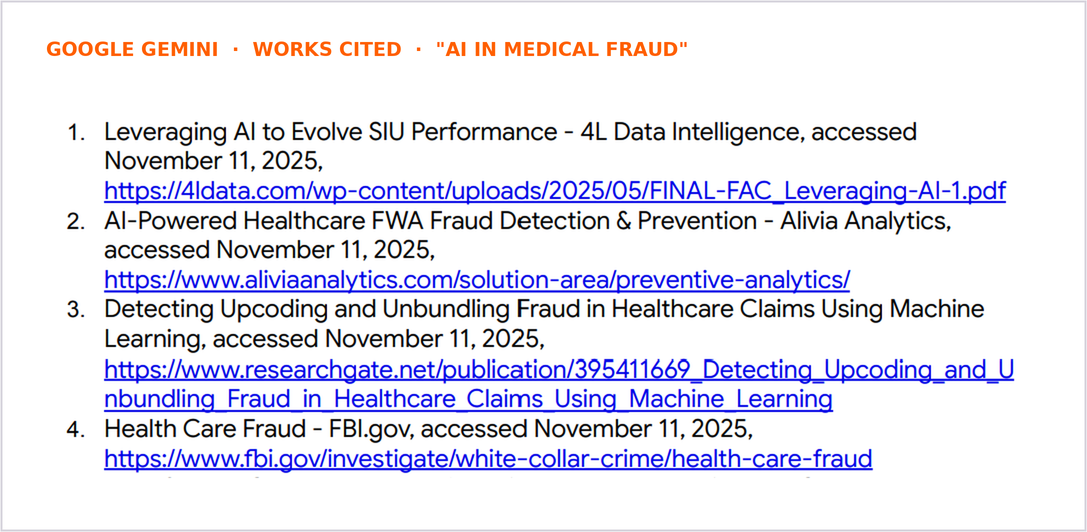
Google’s AI now names 4L Data as its first source on how AI detects medical fraud, ahead of the FBI and our largest competitor. That happened because we published methodology instead of brochures, and I had to defend that choice when leadership saw what it gave away.

Task

Make 4L Data the source that search engines and language models cite when the market asks how AI detects healthcare fraud.
  • Strategy

    Category Narrative, Content Strategy

  • Design

    GEO, AEO, SEO

  • Client

    4L Data

Role: I own content and search strategy at 4L Data: the category narrative, what gets published, and how it is structured so both search engines and language models can use it.

Context: Healthcare fraud prevention is a category where every vendor publishes the same gated brochure, and none of it earns attention.

What I owned: The shift-left category narrative, the publishing program behind it, the on-page and structured-content work that makes it machine-readable, and the argument for keeping it substantive when that got uncomfortable.

Outcome: Google’s Gemini names 4L Data as its first source on AI in medical fraud, ahead of federal sources and larger competitors. A major academic health system arrived inbound through organic search and is now a live client.

The problem

Everyone publishes, nobody gets read

In this category every vendor publishes the same artifact: a gated PDF that describes the problem in general terms, asserts a capability, and asks for a meeting. It is built to produce a form fill, not to be useful. The result is a whole category of content that is not worth citing, ours included.

That matters more than it did two years ago, because buyers no longer start at a results page. They ask an assistant, and the assistant answers from a short list of sources it has judged credible. If you are not on that list you are not in the consideration set, and nothing tells you that you were left out.

The question stopped being how do we rank. It became a harder one: what would make a machine choose us as the source it explains this category from?

The decision worth explaining

Publish the method, not the brochure

The answer is uncomfortable, which is why most companies in this market do not act on it. A model cites whichever source most usefully explains the thing. Usefully means real methodology: how the schemes actually operate, how detection is structured, what the data shows, at a level of specificity a practitioner would recognize as true.

So that is what we published. Our Fraud Advisory Council white paper went out as an indexed document on the site rather than behind a form, written for a program integrity director who does this for a living. Publication was timed to regulatory moments, every page was structured so the argument is extractable instead of buried inside a layout, and distribution ran through channels that link back and compound rather than campaigns that spend and stop.

None of that is a trick. It is the ordinary discipline of being genuinely the best available explanation of your own category, and then making that explanation easy for a machine to lift.

The engine

A publishing program, not a content calendar

The citation is an output. What produces it is a program with a source of original material at the center.

The Fraud Advisory Council is that center. A standing council of industry practitioners convenes each year, and the session produces a white paper that did not exist anywhere before it. That is the line between publishing and content marketing. The council generates primary material, so the paper is a source rather than a summary of other people’s sources, and a model looking for the best available explanation has a reason to pick it. Further papers are co-authored with industry partners, which puts the argument in front of audiences we do not own and brings their credibility back to ours.

Around every publication runs the same machine: syndication, an original LinkedIn series, an email sequence built per vertical, press releases that link back and compound site authority, and timing so the paper lands when a regulatory or conference moment makes it urgent. The full catalog sits on the company’s news and publications page, categorized by type, which is also what makes it legible to a crawler.

I author, design and run the campaign for every one of them. The byline is not always mine, which is ordinary in B2B, and it does not change who builds the program.

What it cost

The argument I had to hold

When the citation surfaced internally the room split. One half read it as validation of years of work, the kind of position firms spend a long time trying to earn. The other half read the same screen and saw exposure. The sharpest version of that objection was that the paper being cited tells a reader what they would need to do to compete with us.

That objection is not stupid and I did not treat it as such. My position was that the exposure is real and the trade is still right. Authority in this category is not a secret, it is a position, and it is only held by the company the market and the machines treat as the explanation. The specificity in that paper is the reason we hold it. The moat was never the description of the problem. It is millions of provider records reconciled daily against thousands of sources, and nobody reverse-engineers that from a white paper. If the method alone were enough, this category would have more competitors moving the needle than it does.

What came out of it was a review of where the publishing line sits, which is the correct outcome. The publishing did not stop.

What it produced

Cited ahead of the FBI

Asked how AI is used to detect medical fraud, Google’s Gemini returns 4L Data as its first cited source, ahead of the FBI’s own healthcare fraud page and ahead of the largest competitor in the category. Our research and event content peaks near a 23% click-through rate. A major academic health system found us through organic search, came in inbound, and is now a live client.

The one worth watching is the citation, not the click-through. Click-through is a channel metric. A citation is a position: the systems buyers now ask have decided we are the explanation for this category. That compounds, and a competitor cannot buy past it.

What it does not do is prove savings. An industry analyst’s read of this market is that buyers cannot verify any vendor’s savings claims, ours included, and authority content does not close that gap. The next thing I am building is a live, anonymized view of flagged edits and scheme findings, because in a market full of unprovable claims the provable number is the differentiator.

Google Gemini, asked how AI is used to detect medical fraud. 4L Data is the first cited source. The FBI is fourth.
Back