
Pulling the technology out of the product
4L Data’s patented AI was its only real differentiator, and it was invisible to buyers. I built the architecture that pulled it out, gave it a name of its own, and wrote the rule that every product, partner and acquisition since has been tested against.
Recommend a brand architecture for the company, its products and its patented AI technology, and write the rule that decides every naming question after it.
-
Strategy
Brand Architecture, Positioning
-
Design
Naming, Identity System
-
Client
4L Data
Role: I owned the brand architecture strategy end to end, and the identity system built from it.
Context: 4L Data, a healthcare data intelligence company with a patented AI technology, a portfolio of products, vertical operating units and equity partnerships, each named on its own terms and none of them telling a buyer a single story.
What I owned: Five architecture models evaluated against the business, a two-column test for when a product earns its own identity, the recommendation, and the logo and endorsement system that implemented it.
Outcome: A structure that has absorbed roughly twenty new products, operating units, acquisitions and equity partners since, without being reopened.
A portfolio of products and no story
Buyers had no way to understand what they were buying. Every product arrived with its own name and its own logo treatment, and none of them explained how they related to each other or to the company behind them. A payer evaluating one product could not tell whether the rest were the same platform, the same data, or even the same company.
In healthcare technology the buyer is committing to a multi-year relationship with an organization, not to a feature, and the corporate brand is what carries that risk. A portfolio that reads as a set of unrelated tools gets discounted across every one of them.
Three gaps were doing the damage:
- No rule for when a product earned its own identity, so every launch reopened the same argument.
- No way to express the shared technology underneath the products, which was the differentiator and was invisible to the buyer.
- No structure for partners and acquired technology, which were arriving faster than we could name them.
Five models, then a two-column test
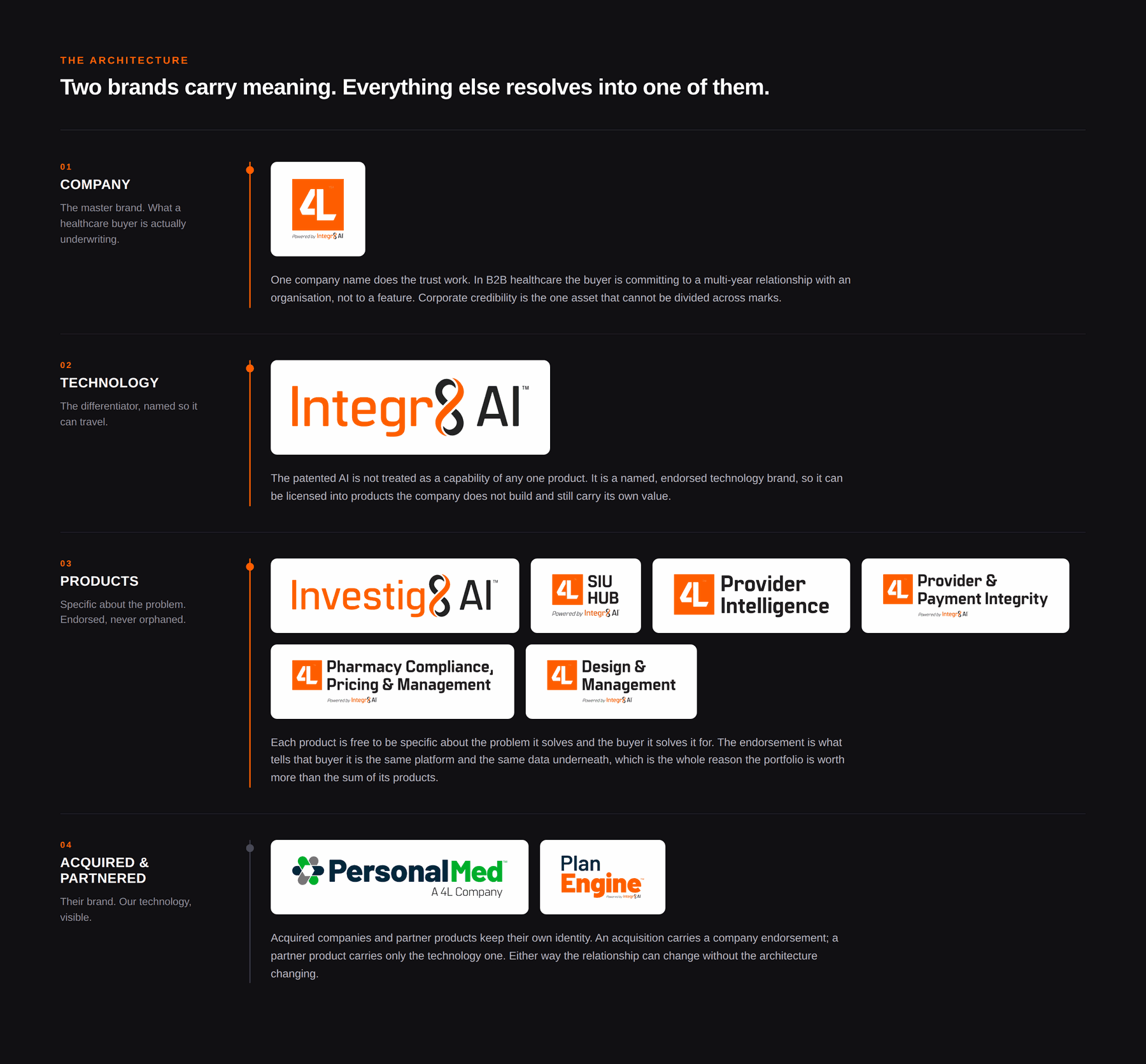
I evaluated five models against how this business sells: branded house, sub-brand, endorsed, house of brands, hybrid. Two structural precedents shaped the answer. Alphabet, where a holding structure protects the core brand while other units run and exit independently. Qualcomm, where a licensed technology brand travels into products the parent does not build.
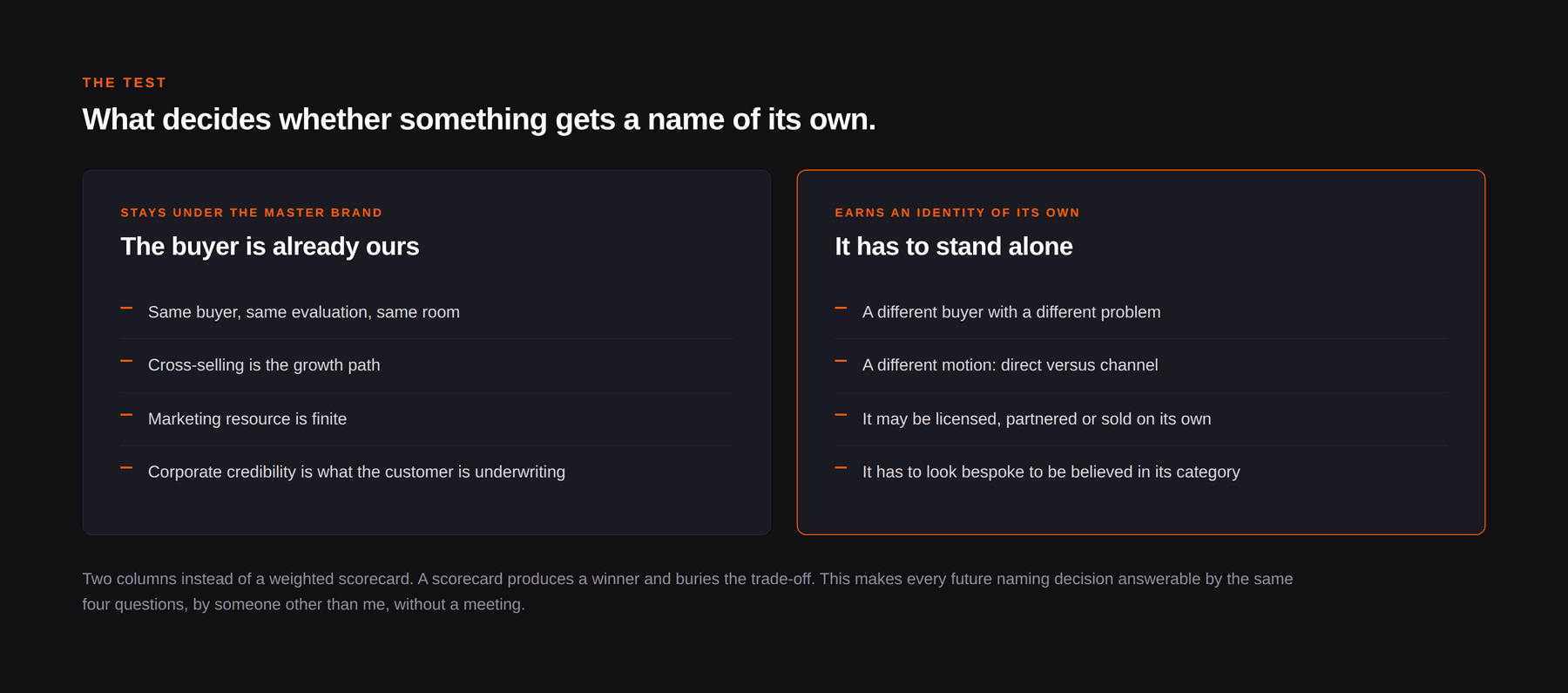
I replaced the scorecard with a two-column test.
A product earns its own identity when it sells to a different buyer, moves through a different go-to-market motion, or is likely to be licensed, partnered or sold on its own.
It stays under the master brand when the buyer is the same, cross-selling is the growth path, marketing resource is finite, and corporate credibility is what the customer is underwriting.
Two columns instead of weighted scores was deliberate. A scorecard produces a winner and hides the trade-off inside the weights. Four questions can be answered by a product lead in a doc, without me, and the answer is arguable on the questions rather than on the score.
The technology is the asset, not a feature
The default reading was that the AI is a capability of the flagship product, the thing that makes the platform better. That is how it had always been described.
I argued the opposite. Snapdragon is not a phone. It is a technology brand named, marketed and licensed independently of the devices it goes into, and that independence is what lets it travel into hardware Qualcomm does not build. A capability buried inside a product is worth whatever that product is worth. A capability with its own name and a visible endorsement can be licensed, partnered and carried into products the company does not own.
Three things had to hold at once: where the business was going, what a buyer needed to believe to sign, and what each piece had to be worth if it were sold separately.
An endorsed technology brand was the only model that satisfied all three. It gives a buyer one thing to trust across every product, and it gives each product room to be specific about the problem it solves.
That argument is no longer theoretical. The technology now reaches customers two ways: organizations that buy the platform directly, and organizations that license it into their own stack and sell it on to their own clients. The second group is about a third of the book. That revenue exists because the technology carries a name a partner can put in front of their own customers, which is the thing a capability buried inside a product can never do.
The argument I had to win
The hardest pushback came from the property and casualty side. They sell to insurance carriers, not health plans, and their argument was that a master brand built on healthcare credibility is a liability in a room full of carrier executives. Under my own test they had a case. Different buyer, different motion. That is the column that says break away.
I kept them under the master brand and gave them a distinct product mark with the technology endorsement instead of a separate company brand. What a carrier is underwriting is the same thing a payer is underwriting: whether the detection technology is real, and whether the company behind it will still be there in three years. A separate P&C brand would have started that credibility at zero while splitting the budget that proves it. They gave up independence and got the patent, the case studies and the balance sheet. It was the closest call in the system and I would make it the same way again.
The cost is real and it did not go away. Every product carries a second mark and an endorsement lockup. It takes space, it adds an approval step to work that used to ship without one, and it makes each product quieter in its own category. A team that wants to be the sharpest thing in its market will always want more room than this architecture gives it.
The test is the twentieth product
When this was written the portfolio was a handful of products and a few partnerships. It is now roughly twenty: products, operating units, acquired technology and equity partners. Each one resolves to one of three places. It carries the master brand, it carries its own name with the technology endorsement, or it stays independent with the technology inside it.
None of those arrivals has required reopening the architecture.
One seam is still open. The line between an acquisition and an equity partner is a judgment call, and the mark changes depending on which side of it something lands. When a partner’s stake moves, the brand has to move with it, and nobody budgets for that migration. It has not broken anything yet. It is the part of the model I would design differently if I were starting again.